

Design Director, Rides Studio
Leading system-level product design across Rider and Earner platforms, with a focus on marketplace health, trust, and long-term scale.
Overview
At Uber, the work went beyond designing individual Rider or Earner experiences. It required designing a system where both sides of the marketplace could succeed together. As services expanded and teams moved quickly, the experience risked fragmenting, making discovery harder for riders and slowing progress for earners.
This work was grounded in a simple belief: the marketplace is the product. When discovery feels relevant and earning success happens earlier, the entire system becomes more resilient and sustainable.
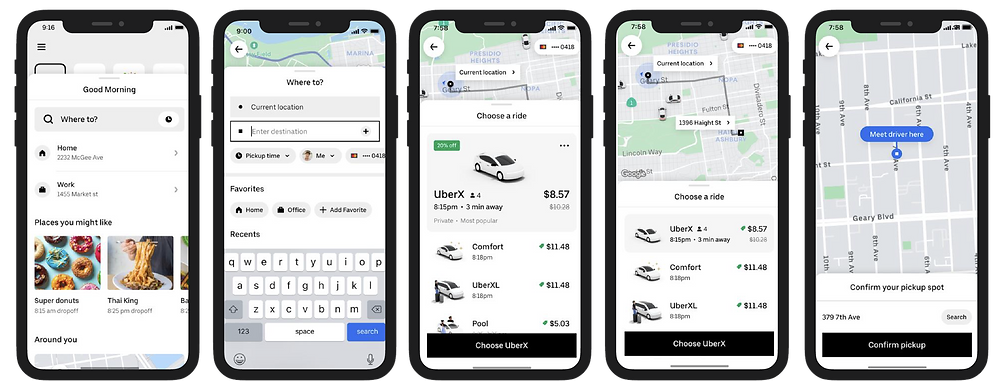
The standard Rider flow was optimized for efficiency, but missed opportunities to personalize and surface discovery when riders would be most receptive.
The Challenge
On the Rider side, the app prioritized speed and efficiency, but discovery of other services became increasingly passive. Over time, bespoke patterns and siloed development introduced inconsistency and design debt, limiting experimentation and clarity.
On the Earner side, teams operated under constant pressure, resulting in reactive delivery. Earners often struggled to understand how to succeed on the platform, delaying confidence and long-term engagement. Without a shared vision, progress remained incremental.


Rider App Kit of Parts
The work focused on creating cohesion without sacrificing flexibility. For Riders, fragmented experiences were unified into a shared foundation that allowed teams to experiment while maintaining consistency. Discovery moments were redesigned to feel contextual and intuitive, reducing overwhelm while encouraging exploration.
The Approach
For Earners, the work began with defining what success looks like and aligning teams around that outcome. A clear narrative helped shape roadmaps and guide sustained investment, while flexible patterns supported a wide range of earning models and customer complexity.
Across both sides, the emphasis was on designing systems that could adapt over time rather than optimizing for single moments.

Impact
For Earners, the onboarding vision quickly translated into roadmap execution and guided over a year of continued work. Clearer paths to success improved confidence and trust earlier in the journey.
Together, these improvements strengthened marketplace health by aligning rider discovery and earner success as mutually reinforcing outcomes.
Across both sides, the emphasis was on designing systems that could adapt over time rather than optimizing for single moments.

Help me track my goals
Help me set my goals
Help me reach my goals
These changes reduced time to product–market fit on the Rider App by roughly half, enabling faster launches and more consistent global experiences. Riders were better able to discover and understand services without added complexity.
Learnings
This work reinforced the importance of designing ecosystems rather than screens. At this scale, trust, clarity, and flexibility are foundational to both experience quality and long-term growth.